Building a public or commercial playground in Texas involves more than selecting durable structures, bright colors, and engaging play features. Project managers, school administrators, and municipal leaders must follow a detailed regulatory framework governing accessibility. Keeping every child safe requires adherence to both state and federal accessibility laws.
Failing to meet these standards can lead to costly retrofits, project delays, and legal liability. Two sets of regulations dictate accessibility for Texas play areas: the Americans with Disabilities Act (ADA) at the federal level and the Texas Accessibility Standards (TAS) at the state level. Correctly applying how these standards interact is vital for any successful park project.
Working with an experienced specialty contractor clarifies design and installation. Decades of hands-on experience across Texas helps your facility meet every mandate while maintaining high play value.
The Federal Baseline: How ADA Applies to Play Areas
Enacted in 1990, the Americans with Disabilities Act establishes civil rights protections for individuals with disabilities. In 2010, the Department of Justice updated these standards to include dedicated criteria for play areas under Section 240 and Section 1008.
Under federal law, playgrounds built by public entities like municipal parks and public schools fall under Title II of the ADA. Privately owned facilities open to the public, such as daycares, churches, and commercial venues, fall under Title III. Regardless of ownership, the core objective is creating play spaces accessible to all children.
Federal ADA guidelines focus on proportional access across two main equipment categories: ground-level components and elevated components. Ground-level components sit directly on the surfacing, while elevated components attach to play structures via platforms.
ADA standards require a specific ratio of ground-level play components along an accessible route. Furthermore, when a playground features elevated components, a set percentage must be accessible via ramps or transfer systems. The safety surfacing must also meet accessibility standards to allow unhindered mobility device movement.
Texas Accessibility Standards (TAS) and TDLR Enforcement
While federal ADA guidelines apply nationwide, Texas maintains state-specific standards. The Texas Accessibility Standards are adopted and enforced by the Texas Department of Licensing and Regulation (TDLR) under Chapter 469 of the Texas Government Code.
TAS aligns with federal ADA requirements, but Texas enforces guidelines through a structured state registration procedure. One specific state rule involves project valuation. In Texas, any public or commercial construction project with an estimated cost of $50,000 or greater must register with TDLR.
For playground projects exceeding this $50,000 threshold, project owners must complete two steps:
- A plan review by a state-certified Registered Accessibility Specialist (RAS) prior to construction.
- An on-site post-construction inspection conducted by a RAS within one year of project completion.
Skipping registration or failing an inspection delays operations and triggers fines. Working with a Texas contractor helps confirm plans align with TDLR specifications before groundbreaking.
Comparing TAS and ADA: Key Overlaps and Distinct Rules
Understanding the relationship between TAS and ADA is necessary for Texas project planners. Rather than competing rules, TAS acts as the state implementation of federal mandates with specific administrative oversight.
Shared Accessibility Objectives
Both regulatory frameworks share technical requirements for play equipment access. Both standards require accessible routes connecting the play area to parking spaces, restrooms, and sidewalks. Ground-level components must offer clear floor spaces and reachable heights for children using wheelchairs.
State Administrative Requirements
The major difference between federal ADA law and Texas state regulation lies in enforcement. Federal ADA relies largely on civil litigation and federal reviews to address non-compliance. In contrast, Texas utilizes TDLR oversight, mandatory plan submissions, and RAS field audits to enforce compliance locally.
Texas state law enforces deadlines for submitting design plans and scheduling post-construction inspections. While federal guidelines define what an accessible play space looks like, TAS and TDLR specify the exact legal process required to open that space in Texas.
Practical Compliance Steps for Texas Playground Projects
Achieving full compliance requires attention at every stage of development, from selecting equipment to installing compliant safety surfacing.
Accessible Routes and Clearances
An accessible route must link the playground perimeter to all accessible play components. These routes require a clear width of at least 60 inches, a maximum cross slope of 1:48, and gentle running slopes. Turnaround areas measuring 60 inches by 60 inches allow proper wheelchair maneuvering.
Selecting Compliant Safety Surfacing
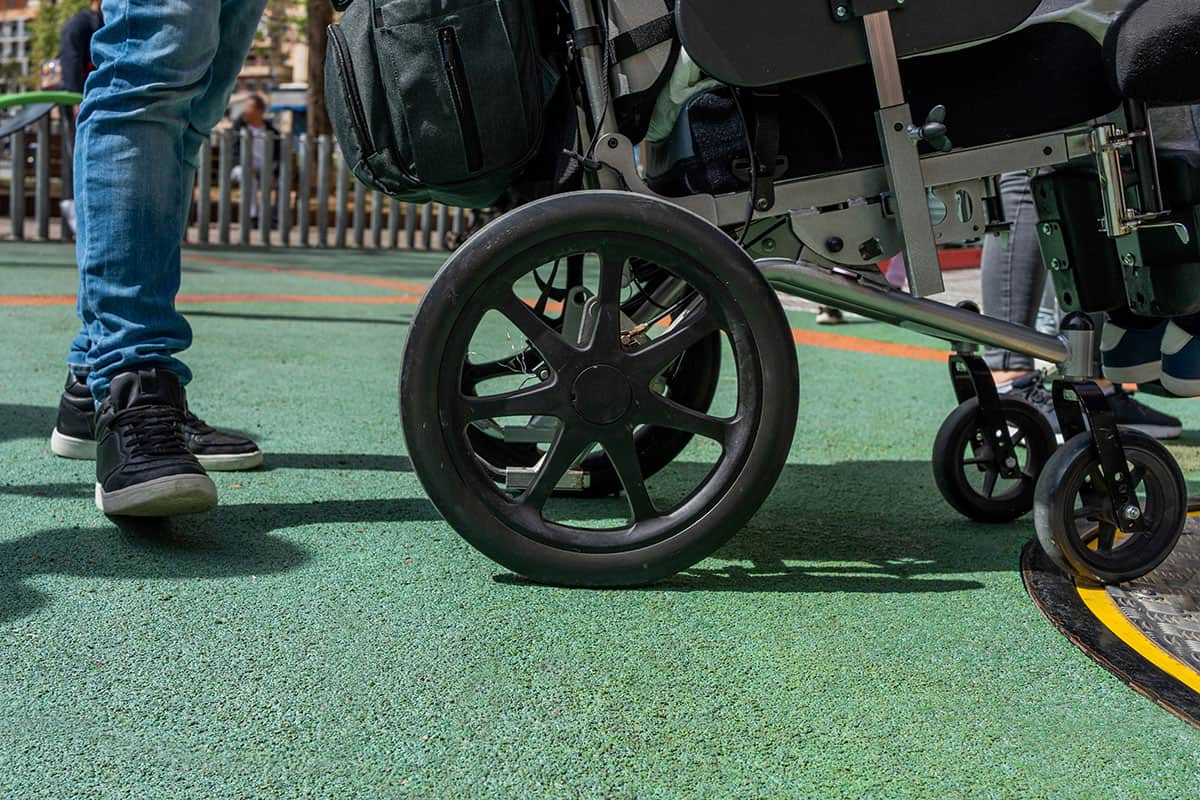
Surfacing is often scrutinized during a TDLR inspection. Under TAS and ADA, safety surfacing within play spaces must meet two distinct standards: ASTM F1292 for impact attenuation and ASTM F1951 for wheelchair accessibility.
Common surfacing options offer varying levels of compliance:
- Poured-in-Place (PIP) Rubber: Provides a continuous surface offering direct accessibility, impact absorption, and low maintenance.
- Rubber Safety Tiles: Offer durability and high accessibility while enabling custom patterns.
- Synthetic Playground Turf: Combines a natural look with cushioned underlayment for accessibility and impact performance.
- Engineered Wood Fiber (EWF): An economical choice requiring frequent raking to remain accessible under ASTM F1951 standards.
Balancing Ground and Elevated Components
Designing a compliant play structure involves calculating the exact number of elevated and ground-level components. For smaller structures with fewer than 20 elevated components, transfer systems are permitted. For larger structures with 20 or more elevated components, at least 50% must be accessible via ramps rather than transfer platforms alone.
FAQs
Does every Texas playground require TDLR registration?
TDLR registration is mandatory for commercial or public Texas playground projects costing $50,000 or more. Projects under $50,000 bypass TDLR registration but must still meet federal ADA accessibility laws.
What is the difference between an ADA compliant surface and an ASTM certified surface?
ADA compliance requires a surface to be accessible to mobility devices, while ASTM standards establish specific testing methods. Playground surfacing must pass ASTM F1951 for wheelchair accessibility and ASTM F1292 for fall protection and impact absorption.
Are transfer stations acceptable for all elevated play structures?
No, transfer stations are only sufficient for structures with fewer than 20 elevated components. Once a play structure reaches 20 or more elevated components, at least half of those accessible components must feature ramps.
Who performs the required TAS accessibility inspection in Texas?
TAS inspections are conducted by a Registered Accessibility Specialist (RAS) licensed by TDLR. The RAS performs an initial plan review before construction and conducts an on-site physical inspection after installation is complete.
How does loose-fill surfacing like wood fiber impact compliance over time?
Engineered wood fiber can meet initial accessibility standards, but shifts as children play. Without consistent maintenance, topping off, and raking, loose-fill materials develop ruts that violate TAS and ADA slope requirements.
Building Compliant Play Spaces for Texas Communities
Designing and installing a compliant playground in Texas requires a structured approach that balances legal requirements with maximum play value. Addressing federal ADA guidelines and Texas-specific TDLR regulations early in the design phase protects your organization from costly redesigns, regulatory delays, and potential liability.
Working with a specialty contractor simplifies every phase of the process. From selecting playground equipment and compliant safety surfacing to managing site preparation and coordinating with Registered Accessibility Specialists, field experience supports proper project execution.
T.F. Harper & Associates brings five decades of construction and playground expertise to park directors, school districts, and developers throughout Texas. Submit your site plans and project details to TF Harper to begin planning your compliant playground.