An accessible route has to connect every part of the school grounds directly to the play space entrance. A clear concrete path from the parking lot, sidewalk, or main school building is useless if it drops off into grass or mud. Students using wheelchairs or walkers cannot push across thick lawn turf or soft soil on their own. The path needs to stay continuous, firm, and flat from end to end.
The walkway itself must measure at least 60 inches wide so two wheelchairs can pass each other or turn around comfortably. Slope is just as critical as width. Any path with an incline steeper than a 1:20 ratio acts as a ramp and needs sturdy handrails, flat landing pads, and a maximum grade of 1:12.
Cross slopes, which tilt side to side across the path, must stay under 1:48. When a path leans too far sideways, wheelchairs can slide off the edge or tip over. Checking the pavement leading up to the play zone is always the best place to start looking for compliance gaps.
1. Improper Ground Surfacing Materials
Surfacing problems cause more ADA compliance failures than actual play equipment. Loose materials like raw wood chips, pea gravel, and sand trap small wheels and crutches. While certified engineered wood fiber passes initial lab tests, it takes constant raking, topping off, and compaction to stay accessible.
To meet federal standards, play area surfaces must pass ASTM F1951 for accessibility and ASTM F1292 for impact absorption. Poured-in-place rubber, rubber tiles, and synthetic turf with aggregate sub-bases hold up best over long periods. They create a firm foundation that stays smooth under heavy foot traffic and rainy weather.
Ground crews need to check surface thickness frequently. Daily play grinds deep ruts under swings and slide exits. These hollow spots form real physical barriers that stop wheels cold and ruin an otherwise compliant space.
2. Lack of Elevated and Ground-Level Play Components
Play areas need a balanced mix of ground-level and raised play choices. An elevated piece rests on an upper platform, while a ground-level piece sits right on the main play surface. Accessibility guidelines require a specific count of ground-level activities whenever raised decks are present.
| Elevated Play Components | Minimum Required Ground-Level Components | Minimum Different Types of Ground-Level Activities |
| 1 | 1 | 1 |
| 2 to 4 | 1 | 1 |
| 5 to 7 | 2 | 2 |
| 8 to 10 | 3 | 3 |
| 11 to 13 | 4 | 3 |
| 14 to 16 | 5 | 4 |
If a structure offers sensory boards, music stations, or steering wheels, set those features at different heights so all kids can join in. Mounting every interactive board on upper platforms behind steps leaves behind children who do not use stairs.
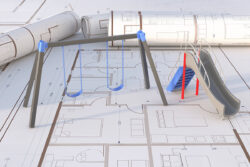
Ground-level features also need clear floor space along a paved path. An activity board shoved into a tight corner behind a support post fails inspection if a child in a wheelchair cannot pull up right next to it.
3. Missing Ramps or Transfer Systems
Getting up to elevated play decks requires either a ramp or a transfer step system. Ramps provide the highest level of access because children can roll straight onto upper decks without leaving their wheelchairs. When a play structure holds 20 or more raised components, at least half of those items must connect directly to ramps.
Transfer systems work as a practical option for smaller play structures. These setups include a low platform, step tiers, and grip handles. A child shifts out of a wheelchair onto a platform set 11 to 18 inches off the ground, then uses their arms to pull themselves up the steps.
If a play structure rises higher than 30 inches and lacks both ramps and transfer steps, it fails federal standards. Handrails on these systems must feature simple grip dimensions and run along the steps without sharp corners or gaps.
4. Inadequate Clear Floor Space and Reach Ranges

Every accessible feature needs a dedicated clear footprint on the deck or ground. This space must measure at least 30 inches by 48 inches so a child using a mobility device can park beside or in front of the activity. If two activity panels sit shoulder-to-shoulder without this footprint, kids cannot use either feature comfortably.
Reach ranges determine how high or low interactive parts can sit. For children ages 3 to 12, handles, steering wheels, and game panels must sit between 20 and 36 inches above the deck floor. Anything mounted higher than 36 inches creates a reach barrier.
Moving parts also must operate with one hand. Controls cannot require tight pinching, twisting, or heavy force. Buttons, dials, and slides should glide smoothly with minimal effort.
5. Missing High-Back or Inclusive Swings
Standard belt seats and tire swings do not offer enough trunk support for kids with limited upper-body control. A swing set filled only with traditional seats excludes many students. An inclusive layout needs at least one adaptive swing seat connected directly to an accessible walkway.
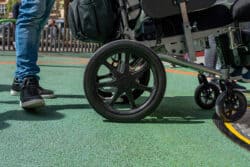
Adaptive swing seats feature tall backs, chest support, and quick-latch safety straps. These seats need to sit next to a firm surface so a classmate or aide can park a wheelchair right beside the seat for safe transfers.
The ground clearance around the swing frame matters just as much. The use zone surrounding an adaptive swing seat needs to stay free of deep wood fiber or raised borders so children have plenty of room to enter and exit.
6. Fixing Playground Accessibility
School play spaces should give every student a fair place to run, swing, and hang out with friends. Catching issues like deep wood mulch, missing transfer decks, or steep concrete ramps helps administrators budget for sensible upgrades. Updating ground surfaces, adding ramps, and spreading out ground-level activities makes the playground safer for the whole school.
To evaluate your current equipment or plan a fully compliant playground update, contact T.F. Harper to review professional planning options.
A Playground Should Welcome Every Child. Here’s How to Tell if Yours Is Falling Short.

Your playground may look safe and functional at first glance, but ADA compliance goes beyond having a few accessible features. If children using wheelchairs, mobility devices, or other accommodations can’t move through the space, reach play components, or participate alongside their peers, it’s time to take a closer look with TF Harper.
FAQs
What is the minimum width for an accessible playground path?
An accessible route must measure at least 60 inches wide so two wheelchair users can pass each other or turn around. The path can narrow down to 36 inches for brief stretches, provided a wider turning space is available right before or after the narrow spot.
Are wood chips ADA compliant for school playgrounds?
Standard wood mulch is not compliant because it shifts under weight and leaves deep ruts. Only specialized Engineered Wood Fiber (EWF) that passes ASTM F1951 tests is allowed, and it takes regular maintenance to stay flat and stable.
How many ground-level activities must a playground include?
The required number of ground-level items depends on how many elevated components sit on the main structure. Higher play decks require a proportional increase in ground-level activities.
Can transfer steps replace ramps on all elevated play structures?
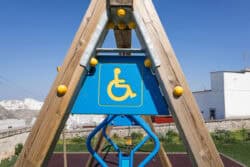
No. On larger play structures with 20 or more elevated components, at least 50% of those features must connect to ramps rather than transfer steps.
What height should interactive panels be mounted at for kids?
Interactive boards, steering wheels, and sound items should sit between 20 and 36 inches off the deck or ground surface. This range lets children seated in wheelchairs or mobility devices reach every control without straining.