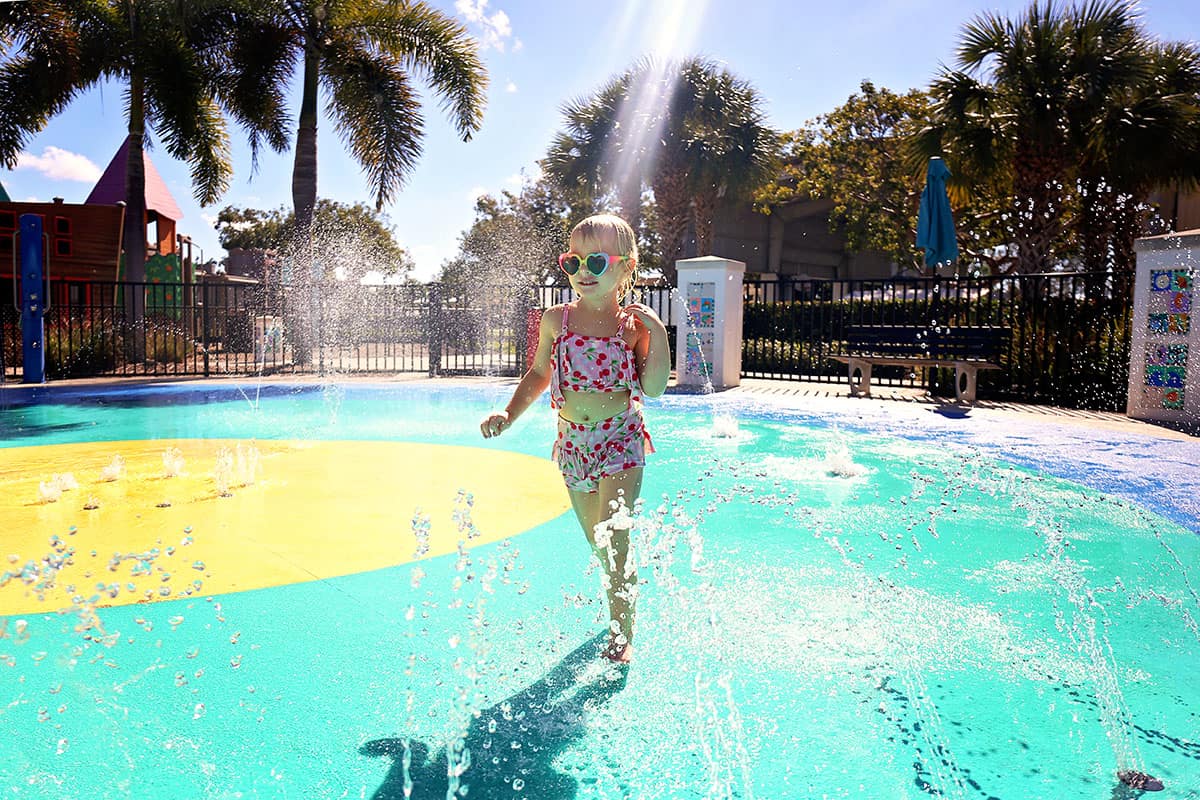
Texas summers routinely push past 100°F for weeks at a time, and outdoor spaces without water simply go unused during the worst of it. That reality keeps pushing municipalities, school districts, and commercial developers toward the same decision: a Austin playground splash pad. Unlike pools, they need no lifeguards, work for toddlers and kids with mobility limitations, and, when well-placed, often become the most-used amenity in a park by midsummer.
The practical question everyone asks first is whether the water bill justifies the installation. It’s a reasonable place to start, but water is typically one of the smaller operational line items once you account for the full cost picture. The more important ROI question is what a splash pad does to overall park attendance, nearby retail activity, and whether it keeps families from driving to a neighboring city’s amenities instead of staying local.
What a Splash Pad Costs to Run
The ROI math only makes sense once you separate capital costs from ongoing operations, they’re two distinct budget conversations that often get conflated in early planning.
Initial construction is the primary capital expense. Scope varies widely: a straightforward installation with a handful of ground nozzles and a basic mechanical room is a very different project than a themed destination pad with dozens of features, shade structures, and custom surfacing. Most community-scale projects fall in a low-to-mid six-figure range, with larger regional installations running higher. The two biggest variables are the number of spray features and the surfacing material, poured rubber costs more upfront than concrete but typically holds up better under heavy foot traffic.
Water use gets the most attention in budget discussions, but on a recirculating system, where water is filtered and reused rather than draining to waste, daily consumption is usually a fraction of what a comparable pool requires. Demand-activated controls, which shut down spray features after a period of inactivity, cut waste further. The real cost variable is whether the system recirculates or runs to drain; for any serious installation, recirculation is worth the added upfront cost.
Water treatment is non-negotiable. State health codes for public splash pads generally mirror pool standards, requiring documented chlorine and pH levels with regular testing. Recirculating systems need the same chemical management as a pool of comparable volume. Budget for chemical costs plus either a certified operator or a contracted testing service, most states require documented water quality logs for any public water play facility.
Ongoing maintenance covers pump and filtration inspections, seasonal winterization to prevent pipe damage during Texas’ brief but genuine hard freezes, and periodic surfacing repairs. Spray nozzles and emitters are the most commonly replaced components on a heavily used pad. Many operators budget an annual maintenance reserve of roughly 5-10% of equipment cost, though actual spend varies by system complexity and usage volume.
Those costs are real, but they’re the wrong side of the ledger to read in isolation. The financial case depends on what a splash pad generates, in attendance, economic activity, and avoided costs, not just what it consumes.
What a Splash Pad Generates for ROI
For municipalities and public parks, the clearest ROI signal is utilization. A splash pad gives residents a reason to use a park during the hottest months, when most outdoor facilities see their lowest attendance. Communities that install them typically find the pad becomes one of the park’s highest-use features within the first summer of operation.
Higher foot traffic has a secondary benefit that parks departments often underestimate: occupied parks feel safer. A busy splash pad draws parents, grandparents, and older siblings who’d otherwise stay home, that passive presence discourages the conditions that make underused parks targets for vandalism. The effect is harder to quantify than attendance counts, but it’s consistently cited in parks planning research as a driver of what urban planners call “eyes on the street”, or in this case, eyes on the park.
- Social Equity: A public pool charges admission and assumes the swimmer can handle deep water. A splash pad removes both barriers, no entry fee, no swimming ability required. Ground-level spray features are fully navigable for children using wheelchairs or walkers, and most installations are ADA-compliant by design. Every kid on the block gets in on the same terms.
- Community Hub: Splash pads draw people outside at predictable times, hot afternoons, summer evenings, which is exactly when neighborhoods tend to go quiet. Parents sit nearby, introduce themselves, and stay longer than they planned. That kind of low-stakes, repeated contact is how neighborhood relationships actually form. You can’t engineer it directly, but you can create conditions for it, and a well-placed splash pad does.
2. For Commercial Developments (Retail Centers, Apartment Complexes):
A splash pad isn’t décor, it’s a traffic driver. For commercial property owners, the value comes from what it does to visitors who stop, watch their kids play, and spend an extra hour on the property.
- Increased Dwell Time and Foot Traffic: Retail planners track dwell time, how long visitors stay, because spending rises with time on property. A splash pad gives families a reason to linger. While the kids play, parents grab coffee, browse stores, or sit down for lunch. A 30-minute shopping errand becomes a two-hour outing, and the surrounding restaurants and shops capture the difference.
- Competitive Advantage: In Texas multifamily markets, where Class A complexes often compete on finishes and fitness amenities, a splash pad stands out because it’s the one amenity children actually ask about by name. Property managers who’ve added them report it comes up repeatedly in leasing conversations with families choosing between similarly priced units. The retention effect is harder to isolate precisely, but fewer turnovers per year is a real cost reduction, vacancy and re-leasing are expensive.
- Marketing and Brand Image: A splash pad in use is a ready-made content source. Parents photograph their kids, tag the location, and share it without any prompting from a marketing team, organic reach that’s difficult to buy directly. For apartment communities and retail centers, it also sends a specific signal about who the development is designed for, which helps attract the family demographic that tends to stay longer and spend more consistently.
3. For School Districts:
Splash pads on school campuses are uncommon but practical where summer programming runs through July and August. They work as incentive structures for end-of-year activities, as a draw for extended-day enrollment, and as a differentiator in competitive enrollment zones. In Texas, where outdoor recess is heat-limited for months at a stretch, a water feature extends the window for meaningful outdoor activity in ways that shade structures and misters alone cannot.
Choosing the Right Delivery Method
How you procure and build a splash pad affects both timeline and final cost as much as any design decision. Texas public entities, school districts, municipalities, and counties, have access to several contracting structures that can compress the schedule by months and reduce exposure to change orders.
Job Order Contracting (JOC)
JOC works well for standard installations or park upgrades where the scope is well-defined and the schedule matters. Because unit prices are pre-negotiated with qualified contractors under an existing JOC contract, procurement can move in weeks rather than months, a practical advantage when a project needs to be operational before Memorial Day.
Construction Manager at Risk (CMAR)
When a project involves custom aquatic design, recirculating filtration systems, or complex site engineering, CMAR provides budget discipline that traditional design-bid-build cannot. The Construction Manager establishes a Guaranteed Maximum Price during the design phase, which shifts cost risk to the contractor rather than the owner. For water features, where mechanical, civil, and health-code requirements interact in ways that can generate expensive surprises, that early-stage GMP is the primary hedge against the overruns that compress returns on a long-lived asset.
Design-Build
A single firm owns the entire project, hydraulic engineering, utility connections, and final surfacing, which eliminates the coordination gaps that plague multi-contractor jobs. For a school district, that matters: when the nozzle layout doesn’t match the drainage plan, there’s one contract and one party responsible for fixing it. The design-build team carries the project from civil design through commissioning, which compresses the schedule and removes the district from the role of managing handoffs between separate designers and contractors.
FAQs
What is the difference between a “flow-through” and a “recirculating” splash pad system?
Flow-through is the simpler option: fresh city water runs through the features and drains directly to the sanitary sewer. Upfront costs are lower, but the water bill reflects every gallon that passes through, a busy pad can cycle through hundreds of thousands of gallons over a full summer season, none of it reused. A recirculating system works like a swimming pool: it collects, filters, and chemically treats the water in a closed loop before sending it back through the features. Construction costs are higher because of the filtration vault, chemical treatment equipment, and holding tank, but ongoing water consumption drops sharply, most of what’s lost is evaporation and splash-out rather than constant throughput. For any public installation running a full season, recirculating is the standard approach; the higher initial investment typically pays back in reduced utility costs within a few years.
How much water does a modern recirculating splash pad actually use?
A recirculating system isn’t consuming fresh water with every use, it’s circulating the same volume. The losses are evaporation (which accelerates in Texas summer heat) and splash-out from active play. The rate depends on pad size, daily operating hours, and ambient conditions, but makeup water, the fresh water added to replace those losses, is a fraction of total system volume per day. User-activated controls, where features only run when triggered, reduce both evaporation and splash-out compared to continuously running fixtures. The practical result is that a recirculating pad’s water consumption is closer to what a large landscaped area uses than what an equivalent-sized swimming pool requires.
Can a splash pad be built in phases to manage costs?
Yes, and planning for it from day one is what makes phasing work. The expensive part to modify later is the underground infrastructure, main supply and return lines, the filtration vault, electrical conduit. If that infrastructure is sized for the eventual full installation upfront, surface features can be added in later phases without excavating again. A phase-one build typically covers the mechanical room, utilities, and a core set of features; subsequent phases add spray elements, expand the pad footprint, or upgrade the feature package as budget becomes available. The critical step is having the complete long-range plan finalized before breaking ground, so the initial civil work doesn’t become a constraint later.
Are splash pads safer than traditional swimming pools?
Generally, yes, with one important qualification. Zero-depth design removes drowning risk entirely, which is why splash pads work well for schools and public parks that operate without constant supervision. Drowning is the leading cause of accidental death for children under five, according to the CDC, so eliminating standing water is a meaningful and measurable safety gain. The trade-off is water quality: recirculating systems that aren’t properly maintained can harbor waterborne pathogens including Cryptosporidium and Legionella. Regular water quality testing and a documented maintenance schedule aren’t optional, they’re what keeps a zero-drowning-risk facility from creating a different kind of public health exposure.
How much does a commercial splash pad cost to build in Texas?
A small flow-through installation starts around $100,000; a large, custom recirculating park with elaborate features can run $500,000 or more. The biggest variable isn’t the spray features, it’s the water system. Flow-through skips the filtration vault and holding tank, which lowers the initial number but shifts expense to the monthly water bill. For public agencies managing capital budgets, Job Order Contracting (JOC) is worth evaluating: it lets organizations purchase construction work at pre-negotiated unit prices through an existing contract vehicle, bypassing a full competitive bid process for each individual project. That compresses the procurement timeline and gives budget planners predictable per-unit pricing before a project is formally approved.
Can splash pad water be used for irrigation?
Yes, in flow-through systems, and a number of Texas parks departments already do it. Discharge water routes to adjacent turf or sports fields rather than the storm drain, reducing irrigation draw from the municipal supply. For a mid-sized pad running 8 hours a day through a Texas summer, that water volume adds up quickly. Exact savings depend on site layout and local water rates, but it’s a straightforward way to offset operating costs that often gets overlooked in the initial budget conversation.
What is the average lifespan of splash pad equipment?
Commercial-grade nozzles and pump systems from established manufacturers typically run 10-15 years with consistent seasonal maintenance, winterization, seal replacements, and annual inspections. UV-resistant coatings on the play features hold up similarly under direct Texas sun. Most operators plan a targeted refresh around year 8-10: resurfacing the deck and replacing high-wear nozzles keeps the pad looking current without the cost of a full replacement. Skipping that mid-life investment is usually what shortens the overall lifespan.
Which construction method is best for a school splash pad?
It depends on project scope and schedule. For new installations integrated into a campus master plan, Design-Build or CMAR gives school districts better cost certainty and tighter coordination between the water feature and surrounding infrastructure from the start. For a smaller addition to an existing facility, say, adding a splash element to an existing playground, JOC typically moves faster because the contractor relationship and unit pricing are already established, cutting procurement time significantly.
A Worthwhile Investment for Your Community
The water bill is a real line item, and it deserves a straight answer: for most Texas communities, the operating costs hold up under scrutiny. Splash pads rank among the highest-traffic park amenities during summer months. For mixed-use and retail developments, water play features drive longer dwell times and repeat visits. For municipalities, a well-placed splash pad draws families to parks who wouldn’t otherwise show up, which strengthens the case for the facility’s operating budget year after year. Some of that return shows up in lease renewals, some in parks satisfaction surveys, some in master-plan conversations five years out. But it shows up.
T.F. Harper has designed and built splash pad projects across Texas for municipalities, school districts, and private developers. If you’re working through water consumption estimates, playground equipment in Austin options, or long-term operating costs for a specific site, we can help you run those numbers. Reach out to our construction manager in Austin TX to start the conversation.